
Salesforce + Agentic AI Reference Architecture: Building an Event-Driven Intelligence Layer for the Enterprise
Salesforce AI should not be just a chatbot inside CRM. It should be an event-driven intelligence layer across sales, service, and commerce.

Salesforce AI should not be just a chatbot inside CRM.
It should be an event-driven intelligence layer across sales, service, and commerce.
That is the architectural shift enterprise teams need to make.
Many organizations are currently thinking about Salesforce AI in a narrow way. They imagine a chatbot embedded inside Salesforce that answers questions, summarizes records, or helps users search knowledge articles.
That is useful.
But it is not the full opportunity.
Salesforce already sits at the center of many enterprise business processes. It contains customer data, opportunity data, service cases, commerce activity, work orders, contracts, marketing journeys, customer interactions, and operational workflows.
That means Salesforce should not only be a place where users ask AI questions.
Salesforce should become a source of intelligent business events.
When something meaningful happens in Salesforce, that event should be able to trigger intelligent automation across backend systems, AI agents, knowledge systems, mobile apps, web apps, and collaboration channels.
That is where Salesforce + Agentic AI architecture becomes powerful.
The core flow looks like this:
Salesforce → Platform Events → Java Spring Boot → Kafka → AI Orchestrator → RAG / Agents → Mobile / Web / CRM
This architecture turns Salesforce from a system of record into an intelligence platform.
Why Salesforce AI Needs an Event-Driven Architecture
Enterprise workflows are not static.
They are event-driven.
A customer creates a service case.
An opportunity moves to a new stage.
A quote is approved.
A contract is uploaded.
A customer changes an address.
A work order is completed.
An SLA is at risk.
A commerce order fails.
A support case receives a new message.
A payment status changes.
A high-value customer signals churn risk.
Each of these events can trigger downstream intelligence.
The question is:
Should these events simply update CRM records?
Or should they activate intelligent workflows?
In a modern enterprise AI architecture, these events should trigger agentic workflows that can understand context, retrieve knowledge, reason over data, call tools, recommend actions, request approvals, and deliver outcomes back to the right channel.
This is why the architecture must go beyond a chatbot.
A chatbot waits for a user to ask a question.
An event-driven AI system reacts to business signals in real time.
That is a much stronger enterprise architecture pattern.
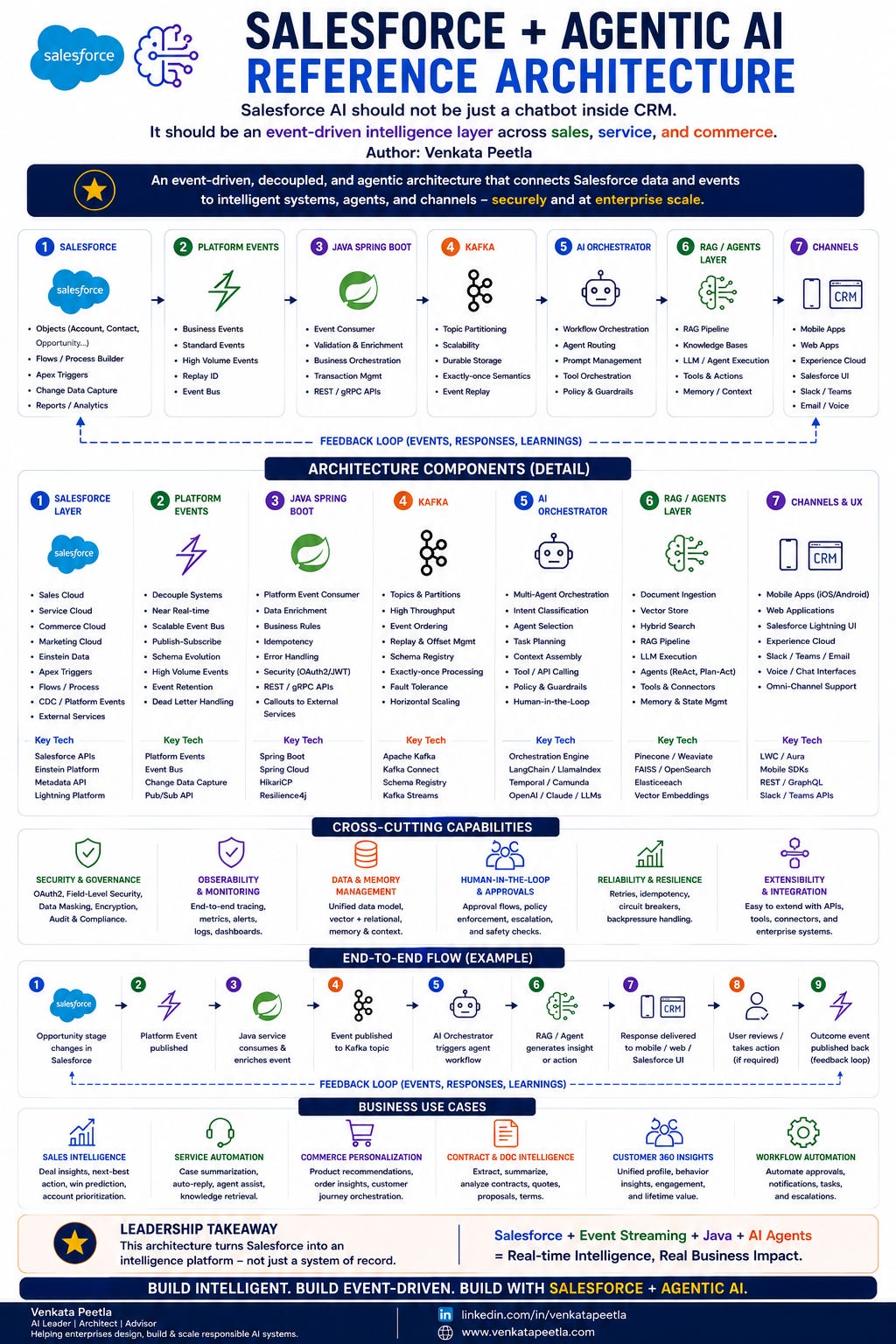
The Reference Architecture
The proposed architecture has seven major layers:
Salesforce layer
Platform Events layer
Java Spring Boot integration layer
Kafka streaming layer
AI orchestration layer
RAG and agents layer
Channels and user experience layer
Each layer has a specific responsibility.
The goal is to keep the system decoupled, scalable, observable, secure, and extensible.
1. Salesforce Layer
The Salesforce layer is the business system of record.
It may include:
Sales Cloud
Service Cloud
Commerce Cloud
Marketing Cloud
Experience Cloud
Custom objects
Apex triggers
Flows and Process Builder
Change Data Capture
Platform Events
External Services
Reports and analytics
Einstein Data
From an AI architecture perspective, Salesforce provides three important things:
Business data
Business events
Business workflows
The data includes objects such as Accounts, Contacts, Opportunities, Cases, Orders, Products, Assets, Work Orders, Quotes, Contracts, and custom enterprise objects.
The events include record changes, status transitions, user actions, workflow triggers, CDC events, and Platform Events.
The workflows include approvals, escalations, assignments, notifications, customer communication, sales processes, and service operations.
This is why Salesforce is such a powerful starting point for agentic AI.
It already contains the business context.
2. Platform Events Layer
Platform Events are a key integration mechanism for event-driven Salesforce architectures.
Instead of tightly coupling Salesforce to every downstream system, Platform Events allow Salesforce to publish meaningful business events to a scalable event bus.
Examples:
OpportunityStageChanged
CaseEscalated
ContractUploaded
WorkOrderCompleted
CustomerMessageReceived
QuoteApproved
OrderStatusChanged
PaymentFailed
SLAThresholdReached
The Platform Events layer should support:
Event decoupling
Publish-subscribe patterns
Replay IDs
High-volume events
Schema evolution
Event retention
Dead-letter handling
Event versioning
Change Data Capture integration
This layer is important because AI systems should not directly depend on Salesforce transaction logic.
Salesforce should publish clean business events.
Downstream systems should consume, enrich, route, and process them independently.
That creates separation of concerns.
3. Java Spring Boot Integration Layer
The Java Spring Boot layer acts as the enterprise integration and control boundary.
This is especially important in production.
The AI orchestrator should not directly consume every Salesforce event without validation, enrichment, and policy checks.
The Java backend can handle:
Platform Event consumption
Validation
Data enrichment
Business rules
Idempotency
Error handling
Transaction management
REST and gRPC APIs
Security and authentication
OAuth/JWT handling
External service calls
Mapping Salesforce objects to domain models
Publishing validated events to Kafka
This layer is where enterprise engineering discipline matters.
It provides a stable backend foundation between Salesforce and the AI ecosystem.
For example, when a Salesforce event is published, the Java service can:
Validate the event schema
Check whether the event is relevant
Enrich it with account or product metadata
Apply business rules
Mask sensitive fields if needed
Generate a correlation ID
Publish the event to the appropriate Kafka topic
Log the event for observability
This prevents the AI system from becoming tightly coupled to raw Salesforce events.
4. Kafka Event Streaming Layer
Kafka provides the scalable event backbone for enterprise AI workflows.
Once events leave Salesforce and pass through the Java integration layer, Kafka can distribute them to AI orchestrators, analytics systems, notification systems, data platforms, and operational services.
Kafka supports:
Topics and partitions
High-throughput event processing
Event ordering
Replay and offset management
Schema registry
Horizontal scaling
Fault tolerance
Durable event storage
Exactly-once processing patterns
Backpressure handling
Event-driven microservices
This is critical for enterprise AI because agent workflows may need to react to events in real time, but also replay events for recovery, debugging, analytics, or retraining.
Kafka also helps decouple producers and consumers.
Salesforce does not need to know which AI agents, data pipelines, or downstream systems will consume the event.
The architecture becomes more flexible.
5. AI Orchestration Layer
The AI orchestrator is the brain of the agentic system.
This layer should not be confused with the model router.
The orchestrator controls the workflow.
It decides what needs to happen next.
It may use models, tools, retrieval systems, APIs, policies, memory, and human approvals to complete a business process.
The AI orchestration layer should support:
Intent classification
Task planning
Agent selection
Multi-agent coordination
Tool calling
Context assembly
Policy enforcement
Guardrails
Human-in-the-loop approvals
Workflow state management
Retries and recovery
Model routing
Prompt management
Observability
Evaluation feedback
Examples of orchestration decisions:
Should this event trigger an AI workflow?
Which agent should handle it?
Does this require retrieval?
Does the agent need Salesforce data?
Does the agent need to call an external API?
Does the action require human approval?
Which model should be used?
What guardrails apply?
Where should the response be delivered?
In a production architecture, the orchestrator must be stateful, observable, and governed.
It should not be a simple prompt chain.
6. RAG and Agents Layer
The RAG and agents layer provides domain intelligence.
This layer may include:
Document ingestion
Knowledge bases
Vector databases
Hybrid search
Re-ranking
Knowledge graphs
LLM execution
Tool connectors
Salesforce APIs
External APIs
Memory and context management
Domain-specific agents
Action agents
Analysis agents
Communication agents
For Salesforce use cases, retrieval may involve:
Customer history
Account data
Service cases
Knowledge articles
Product documentation
Warranty documents
Contracts
Quotes
Order history
Policy documents
Internal SOPs
Field service notes
Marketing interactions
A RAG pipeline helps ground the AI system in enterprise knowledge.
Agents use that knowledge to perform tasks.
Example agents:
Sales Intelligence Agent
Service Automation Agent
Customer 360 Agent
Contract Intelligence Agent
Commerce Personalization Agent
Workflow Automation Agent
SLA Risk Agent
Next Best Action Agent
Customer Communication Agent
The key is that agents should not operate independently without governance.
They should be orchestrated, monitored, evaluated, and controlled.
7. Channels and User Experience Layer
The final output should reach users where they work.
That may include:
Salesforce Lightning UI
Salesforce console
Mobile apps
Web applications
Experience Cloud portals
Slack
Microsoft Teams
Email
Voice and chat interfaces
Omni-channel support systems
This is important because enterprise AI should not force users into a new interface for every workflow.
If a sales rep works in Salesforce, AI recommendations should appear in Salesforce.
If a support manager works in Slack, approval requests may appear in Slack.
If a customer uses a mobile app, responses should be delivered through the mobile channel.
The AI architecture should be channel-aware.
End-to-End Example Flow
Let’s walk through one example.
An opportunity stage changes in Salesforce.
The opportunity is updated in Salesforce.
A Platform Event is published.
A Java Spring Boot service consumes the event.
The service validates and enriches the event.
The event is published to a Kafka topic.
The AI orchestrator receives the event.
The orchestrator identifies the workflow.
A RAG agent retrieves account history, prior support cases, product documentation, pricing context, and similar deal patterns.
The AI agent generates a next-best-action recommendation.
If required, a human approval step is triggered.
The response is delivered to Salesforce UI, mobile app, or Slack.
The outcome is logged and fed back into the system.
This is not just AI answering a question.
This is AI responding to a business event.
That is the difference.
Cross-Cutting Capabilities
A production Salesforce + Agentic AI system needs strong cross-cutting capabilities.
Security and Governance
The system must enforce:
OAuth and JWT authentication
Field-level security
Object-level security
Role-based access control
Data masking
Encryption
Audit logging
Compliance policies
Tenant boundaries
Approval controls
AI should never bypass Salesforce security.
If a user does not have access to a record or field in Salesforce, the AI system should not expose it.
Observability and Monitoring
Every workflow should be traceable.
Teams should monitor:
Event flow
Kafka topics
Agent execution
Tool calls
Model usage
Latency
Errors
Retries
Cost
Approval delays
Response quality
Failure patterns
Observability is essential for operating AI in production.
Data and Memory Management
AI systems need more than prompt context.
They need structured memory and state.
This may include:
Conversation memory
Workflow state
User preferences
Customer context
Event history
Agent execution state
Approval state
Knowledge graph relationships
Without durable state, agentic workflows become fragile.
Human-in-the-Loop and Approvals
Not every AI action should be autonomous.
High-risk actions should require approval.
Examples:
Sending customer communication
Changing records
Issuing refunds
Updating contracts
Triggering escalations
Changing order status
Making compliance-sensitive decisions
Human-in-the-loop makes agentic AI safe enough for enterprise workflows.
Reliability and Resilience
The system must handle:
Retries
Timeouts
Dead-letter queues
Circuit breakers
Backpressure
Duplicate events
Idempotency
Partial failures
Fallback models
Graceful degradation
This is where traditional distributed systems thinking becomes critical.
Extensibility and Integration
The architecture should be easy to extend.
New agents, tools, APIs, channels, and business workflows should be added without redesigning the entire system.
This is why event-driven architecture and clear orchestration boundaries matter.
Business Use Cases
This architecture can support many high-value enterprise use cases.
Sales Intelligence
AI can analyze opportunity events, customer history, product interest, engagement signals, and similar deals to recommend next best actions.
Service Automation
AI can summarize cases, suggest responses, route tickets, detect SLA risks, and assist service agents.
Commerce Personalization
AI can personalize product recommendations, order insights, customer journeys, and commerce experiences.
Contract and Document Intelligence
AI can extract, summarize, compare, and analyze contracts, quotes, proposals, invoices, and policy documents.
Customer 360 Insights
AI can unify profile, behavior, service, sales, and lifecycle data to generate customer-level insights.
Workflow Automation
AI can automate approvals, notifications, task generation, escalation handling, and operational follow-ups.
Why This Architecture Is Differentiated
This architecture is powerful because it combines four disciplines:
Salesforce architecture
Enterprise integration
Event streaming
Agentic AI
Many AI solutions focus only on the model.
Many Salesforce solutions focus only on CRM customization.
But the real enterprise value comes from connecting Salesforce events to intelligent systems that can reason, retrieve, act, and learn.
That is why this architecture is differentiated.
It treats Salesforce as the enterprise event source.
It treats Java as the integration and governance boundary.
It treats Kafka as the scalable event backbone.
It treats the AI orchestrator as the intelligent control plane.
It treats RAG and agents as the reasoning and action layer.
It treats mobile, web, CRM, and collaboration tools as user experience channels.
Leadership Takeaway
This architecture turns Salesforce into an intelligence platform, not just a system of record.
That is the leadership-level shift.
Salesforce already holds critical customer and business context.
The opportunity is to activate that context through event-driven AI.
The organizations that win will not simply add chatbots to CRM.
They will build intelligent, event-driven operating systems across sales, service, and commerce.
The formula is clear:
Salesforce + Event Streaming + Java + AI Agents = Real-Time Intelligence and Real Business Impact
Final Thought
Salesforce AI should not be limited to conversational interfaces.
It should become an event-driven intelligence layer.
Every important business event should be an opportunity for AI to assist, recommend, automate, escalate, or improve the customer experience.
That is how enterprise AI moves from passive assistance to active intelligence.
Build intelligent.
Build event-driven.
Build with Salesforce + Agentic AI.