
The Agent Trajectory Optimization Layer
Why enterprise agents need more than traces, dashboards, and token metrics

Why enterprise agents need more than traces, dashboards, and token metrics
Agent logs tell you what happened. Trajectory intelligence tells you why it failed—and what should be removed.
Enterprise AI platforms have invested heavily in observability.
Modern agent runtimes can capture model calls, prompts, retrieved documents, tool invocations, state transitions, token usage, latency, errors, policy decisions, and final responses.
This telemetry is essential.
But telemetry alone does not create understanding.
A trace may show that an agent:
executed 18 steps,
called five tools,
used two models,
consumed 70,000 input tokens,
triggered three retries,
and eventually failed.
Yet the trace may still not answer the questions that matter most:
Which decision first pushed the workflow toward failure?
At what point did recovery become unlikely?
Was the final error the cause or merely the symptom?
Which evidence influenced the incorrect decision?
Which observations were never used?
Which retries repeated the same strategy?
Which context had expired but remained active?
Could the successful path have been shorter?
Would the next model or prompt release reproduce the same failure?
These are not conventional logging questions.
They are trajectory intelligence questions.
An agent trajectory is the complete decision process that connects a business objective to an outcome:
Goal → Plan → Evidence → Reasoning → Action → Observation → State Transition → Recovery or Completion
That trajectory contains more than events.
It captures how the system interpreted the task, selected tools, accumulated context, reacted to failures, applied policies, and arrived at its final result.
This creates the need for a new enterprise platform capability:
The Agent Trajectory Optimization Layer
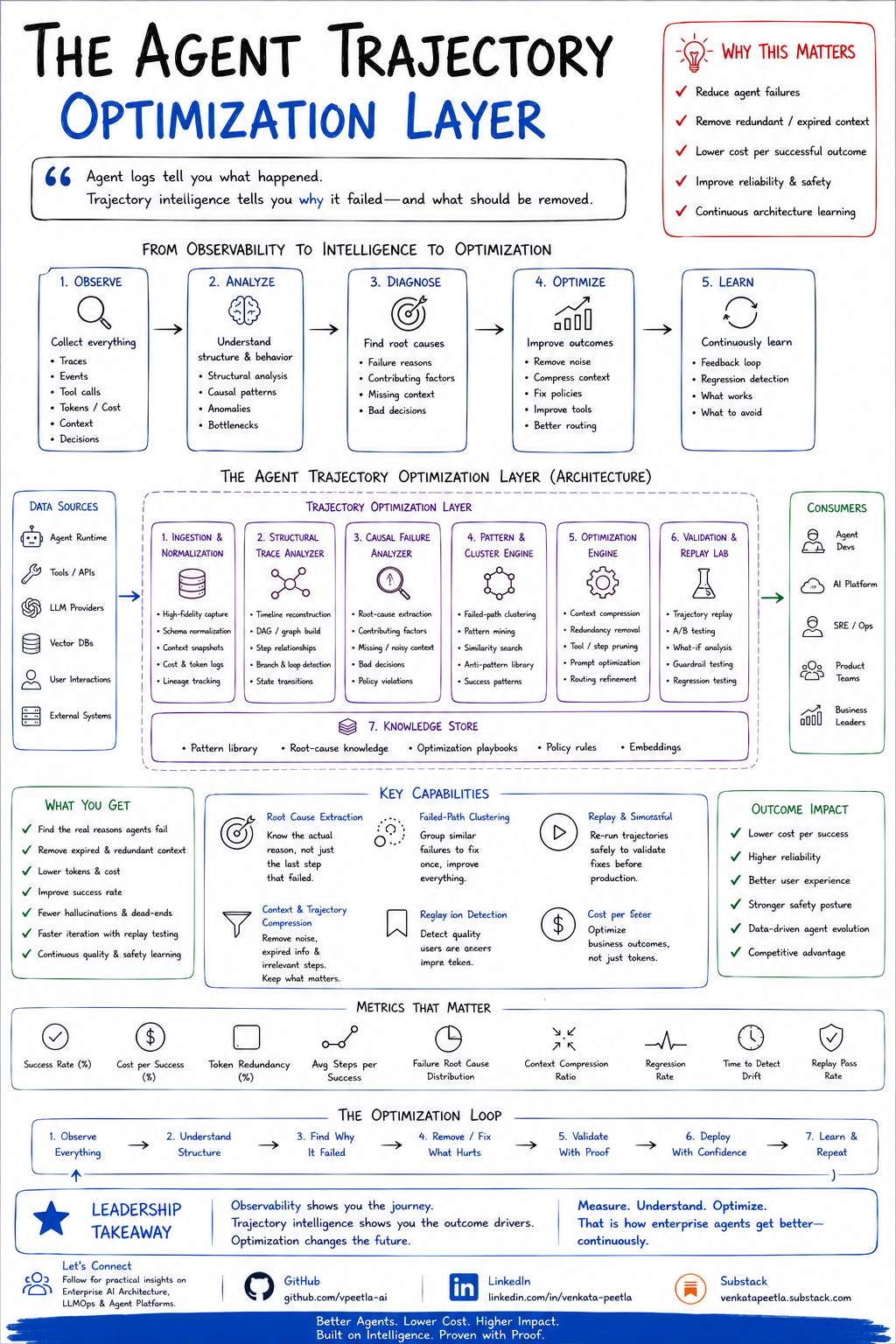
From Agent Observability to Trajectory Intelligence
Traditional observability tends to represent an agent execution as a chronological sequence:
Step 1 → Step 2 → Step 3 → Step 4 → FailureThat view is useful for inspection.
But long-running agents rarely behave as simple linear pipelines.
A realistic workflow may contain:
a planner creating parallel workstreams,
retrieved evidence influencing several later decisions,
retries that return to earlier states,
fallback models activated by quality or latency thresholds,
tool outputs that invalidate an earlier plan,
memory retrieved from previous sessions,
human approval steps,
policy checks that redirect or terminate execution.
The actual structure may look closer to this:
User Objective
      ↓
Planning Decision
      ↓
Retrieval Strategy
      ↓
Weak Evidence
      ↓
Incorrect Tool Selection
      ↓
Repeated Tool Failure
      ↓
Fallback Model
      ↓
Policy Rejection
      ↓
Final Failure
A basic dashboard may attribute the failure to the policy rejection because that is the final visible event.
A trajectory-aware platform should determine whether the true cause began earlier—perhaps when the planner selected a strategy that could not succeed with the available evidence.
This distinction is fundamental:
Failure manifestation: where the problem became visible.
Critical failure step: where the workflow became unrecoverable.
Root causal decision: the earlier choice that created the failed path.
Contributing conditions: context, tools, state, models, policies, or infrastructure that increased the likelihood of failure.
AgentRx formalizes this kind of diagnosis by locating critical failure steps and producing an auditable validation record based on execution trajectories. AgentTrace reconstructs causal graphs from logs and traces backward from the visible error to rank likely root causes.
Why Flat Traces Are Not Enough
1. Chronology does not establish causality
The last failed tool call is often treated as the cause because it is closest to the final error.
But that tool may have received invalid arguments.
Those arguments may have resulted from weak retrieved context.
The weak context may have resulted from an incorrect query strategy.
And that query strategy may have originated in a flawed planning decision.
The nearest error is not necessarily the root cause.
A trajectory optimization layer must reconstruct the dependency chain across:
plans,
evidence,
state,
model outputs,
tool arguments,
policy decisions,
retries,
fallbacks,
approvals.
Only then can the platform distinguish a symptom from the decision that created it.
2. Failure is often a process, not an event
Many agent failures emerge gradually.
A flawed assumption may enter the trajectory early, remain hidden through several plausible-looking actions, and become visible only after the system has exhausted its recovery options.
A 2026 empirical study of CLI coding-agent trajectories analyzed failure onset, evolution, and recovery across thousands of execution traces. It found that failures often began in the first few steps and remained latent until successful recovery was no longer feasible.
This suggests that evaluating only the final answer is too late.
Enterprise platforms need intermediate trajectory checkpoints capable of asking:
Is the current plan still feasible?
Has enough evidence been collected?
Is the agent repeating a failed strategy?
Has the context become internally inconsistent?
Is the remaining recovery budget sufficient?
Should the workflow escalate, re-plan, or stop?
The architecture should intervene before the final error—not merely explain it afterward.
3. More context can make the agent worse
Long-running agents continually accumulate information:
user messages,
system instructions,
planning notes,
retrieved documents,
tool results,
errors,
retries,
revised plans,
memory,
policy responses.
Not all of that information remains useful.
Over time, a trajectory may contain:
duplicated observations,
completed branches,
abandoned plans,
resolved errors,
stale facts,
superseded tool outputs,
instructions that are no longer relevant.
This increases token usage and can also distract the model from the current state.
AgentDiet studies this problem directly. Its authors report that useless, redundant, and expired information is widespread in agent trajectories and can be removed during execution without compromising task performance in their evaluated settings.
The enterprise implication is not simply “summarize more.”
It is:
Measure the future utility of every context item.
Some content should remain active.
Some should be converted into structured state.
Some should be archived outside the prompt.
Some should be removed.
4. One failed trace hides platform-wide patterns
An individual execution may look like a unique incident.
Across thousands of runs, repeated structural patterns begin to appear.
Examples include:
Retrieval starvation
The planner creates a feasible plan, but retrieval repeatedly returns insufficient evidence. The executor continues instead of escalating.
Retry without strategy change
The agent repeats the same tool call with minor argument changes but acquires no new information.
Late verification
The verifier detects the issue only after an expensive or irreversible action has already occurred.
Context contamination
Expired or superseded information remains in the active context and influences later decisions.
Fallback incompatibility
A fallback model produces a response format that downstream orchestration cannot process.
Policy conflict
The planner repeatedly generates actions that cannot pass established business or security policies.
These are not isolated bugs.
They are failed-path families.
Enterprise platforms need to cluster them structurally so teams can fix the pattern once rather than investigate every occurrence independently.
Reference Architecture
The Agent Trajectory Optimization Layer should sit between raw telemetry and downstream evaluation, release governance, and optimization services.
┌───────────────────────────────────────────────────────────┐
│ Enterprise Applications and Agent Experiences             │
│ Service | Sales | Supply Chain | Engineering | Operations │
└─────────────────────────────┬─────────────────────────────┘
                              │
┌─────────────────────────────▼─────────────────────────────┐
│ Agent Runtime                                             │
│ Planner | Retriever | Executor | Verifier | Human Approval│
│ Models | Tools | RAG | Memory | State | Policies          │
└─────────────────────────────┬─────────────────────────────┘
                              │
┌─────────────────────────────▼─────────────────────────────┐
│ Structured Trajectory Capture                            │
│ Decisions | Evidence | Tool I/O | State | Identity        │
│ Prompt/Model Versions | Policies | Cost | Outcome         │
└─────────────────────────────┬─────────────────────────────┘
                              │
┌─────────────────────────────▼─────────────────────────────┐
│ AGENT TRAJECTORY OPTIMIZATION LAYER                       │
│                                                           │
│ Structural Trace Analyzer                                 │
│ Causal Root-Cause Engine                                  │
│ Failed-Path Clustering                                    │
│ Context Utility Analyzer                                  │
│ Trajectory Compression                                    │
│ Replay and Counterfactual Testing                         │
│ Regression and Drift Detection                            │
│ Cost-per-Outcome Optimizer                                │
└──────────────┬────────────────────┬───────────────────────┘
               │                    │
┌──────────────▼──────────┐  ┌──────▼──────────────────────┐
│ Evaluation and Release  │  │ Platform Optimization       │
│ Quality gates           │  │ Prompt and policy tuning    │
│ Canary comparison       │  │ Model and tool routing      │
│ Regression blocking     │  │ Context-budget optimization │
└─────────────────────────┘  └─────────────────────────────┘
The key architectural principle is that raw traces should not flow only into dashboards and archives.
They should be transformed into a structured representation that supports diagnosis, comparison, replay, compression, and optimization.
Seven Core Platform Capabilities
1. Structural Trace Analysis
The first responsibility is converting raw events into an execution topology.
Each node may represent:
user intent,
agent decision,
retrieved evidence,
model invocation,
tool action,
state transition,
memory read or write,
policy decision,
approval,
failure,
business outcome.
Edges should describe relationships such as:
depends on,
influenced,
produced,
retried,
replaced,
contradicted,
validated,
blocked,
escalated.
This enables queries that flat logs cannot answer:
Which evidence influenced this tool selection?
Which upstream agent produced the state used by the verifier?
Which retry repeated the same strategy?
Which model or prompt version introduced this branch?
Which earlier decision affected several downstream failures?
The output should be a navigable execution graph, not merely a formatted trace.
2. Root-Cause Extraction
Root-cause extraction should work backward from the failed outcome.
A defensible process includes:
Identify the failure manifestation.
Reconstruct upstream dependencies.
Validate expected constraints at each step.
Find the earliest meaningful violation.
Determine whether recovery was still possible.
Separate causal factors from contributing factors.
Produce evidence supporting the diagnosis.
Possible root-cause categories include:
incorrect planning,
insufficient evidence,
stale or contradictory context,
model reasoning failure,
invalid tool output,
state inconsistency,
policy conflict,
authorization failure,
orchestration defect,
external dependency failure,
delayed human approval.
The diagnosis should include:
likely root cause,
confidence level,
critical failure step,
supporting evidence,
affected components,
last recoverable point,
recommended remediation.
The platform should never present a root-cause conclusion without showing the trajectory evidence that supports it.
3. Failed-Path Clustering
Root-cause extraction explains one execution.
Failed-path clustering explains the platform.
Trajectories should be clustered using structural features such as:
agent-role sequence,
tool-call sequence,
branch topology,
failure location,
repeated-state pattern,
recovery behavior,
model and prompt versions,
policy transitions,
context growth,
business outcome.
This creates reusable failure classes rather than isolated incidents.
A failed-path cluster should contain:
representative trajectories,
frequency,
affected workflows,
associated releases,
cost impact,
risk impact,
common causal features,
recommended mitigation.
These clusters can drive:
platform backlog,
prompt improvements,
tool redesign,
model-routing changes,
policy updates,
targeted evaluation suites,
agent training or fine-tuning data.
4. Context Utility Analysis
Every item placed into an agent’s active context has a cost and a potential behavioral effect.
The platform should therefore classify context by utility.
A practical classification model is:
Essential
Directly required for an unresolved decision or future action.
Supporting
Provides evidence, confidence, or auditability but is not required verbatim in the active prompt.
Redundant
Duplicates information already represented elsewhere.
Expired
Was relevant earlier but is no longer valid.
Unused
Was added to context but did not influence any later decision.
Harmful
Contributed to a wrong plan, incorrect action, or failed recovery.
Policy-required
Must be retained for compliance, audit, or safety reasons even when it is not needed in active inference context.
This classification allows the platform to ask:
Which observations still affect unresolved work?
Which facts have been superseded?
Which tool result has already been converted into structured state?
Which evidence must remain verbatim?
Which information can be summarized?
Which information can leave the active context entirely?
5. Context and Trajectory Compression
Trajectory compression should not be treated as generic summarization.
A summary can preserve the same irrelevant content in fewer words.
Optimization should instead transform the trajectory based on future utility.
Examples include:
removing duplicate observations,
replacing verbose tool output with validated structured facts,
collapsing completed branches,
retaining only unresolved constraints,
converting conversation history into explicit workflow state,
removing superseded plans,
consolidating repeated errors into one diagnostic record,
preserving references to full evidence outside the active prompt.
A robust architecture should maintain two separate representations.
Full evidence trajectory
An immutable record retained for audit, security, replay, evaluation, and incident investigation.
Optimized active trajectory
The minimum information required for the next decision.
This separation is critical.
Removing content from the model’s active context should not mean deleting the evidence from the enterprise record.
6. Replay and Counterfactual Testing
Every failed trajectory should become a regression asset.
The platform should support replay using:
a new model,
an updated system prompt,
a new tool version,
a changed routing rule,
different retrieval results,
compressed context,
a stronger verifier,
updated policies.
Replay answers:
Would the updated platform avoid this historical failure?
Counterfactual replay asks:
What would have happened if a different decision had been made at the critical step?
Examples include:
selecting a stronger planning model,
stopping after insufficient retrieval,
requiring human review,
selecting another tool,
removing expired context,
changing the verifier model,
invoking a fallback earlier.
Replay must isolate side effects through:
mocks,
sandboxes,
simulated APIs,
read-only environments,
transaction rollback,
synthetic credentials.
A production replay engine must never blindly repeat destructive or external actions.
7. Regression Detection and Outcome Economics
A change to any component can alter the shape of the trajectory:
model,
prompt,
retrieval strategy,
tool,
policy,
memory design,
routing logic,
orchestration framework.
A new release may improve final-answer accuracy while:
increasing tool retries,
lengthening the trajectory,
delaying verification,
increasing human escalations,
introducing new failure clusters,
increasing total workflow cost.
Regression detection should compare:
end-to-end success,
critical failure step,
average trajectory length,
repeated-step frequency,
recovery success,
fallback usage,
verification disagreement,
context growth,
total latency,
total cost,
human-review demand,
policy compliance,
business outcome.
The system should detect structural regressions even when aggregate quality metrics remain stable.
A release that introduces a dangerous new path should not pass simply because the average benchmark score improved.
Cost per Successful Outcome
Model platforms commonly report:
cost per model call,
tokens per request,
average latency,
tool-call count.
These metrics are operationally useful.
They do not measure outcome economics.
Consider two executions.
Trajectory A
Cost: $0.40
Steps: 18
Tool failures: 3
Result: task not completed
Trajectory B
Cost: $0.65
Steps: 9
Verification passes: 1
Result: task completed correctly
Trajectory A is cheaper per execution.
Trajectory B is cheaper per successful outcome.
The enterprise metric should be:
Total trajectory cost ÷ successful, compliant business outcomes
That cost should include:
model inference,
retrieval,
vector or search infrastructure,
external APIs,
tool execution,
compute,
retries,
human review,
failure remediation,
downstream operational impact.
The optimization layer should minimize unnecessary work without reducing quality, safety, or governance.
Evidence and Auditability
Trajectory intelligence must not become another opaque AI judgment layer.
Every diagnosis, cluster, compression action, and optimization recommendation should produce proof.
Root-cause evidence
critical step,
violated expectation,
upstream dependencies,
supporting trace references,
confidence,
competing hypotheses.
Compression evidence
content removed,
reason for removal,
utility classification,
retained source reference,
quality comparison before and after.
Replay evidence
original configuration,
new configuration,
controlled differences,
outcome comparison,
side effects prevented.
Release evidence
regression threshold,
affected failure cluster,
representative examples,
cost impact,
business-risk assessment.
This evidence is especially important when the platform begins automatically modifying context, routing models, or changing runtime policies.
Enterprise Operating Model
The optimization layer requires shared ownership.
AI Platform Team
Owns trajectory schemas, telemetry standards, graph construction, replay infrastructure, and optimization services.
Product Agent Teams
Define workflow-specific success criteria, constraints, and known failure patterns.
Evaluation Team
Builds trajectory datasets, replay suites, evaluators, and release thresholds.
Security and Governance
Defines evidence retention, sensitive-data handling, policy checks, and approval requirements.
AI FinOps
Measures cost per successful outcome and identifies expensive trajectory families.
Site Reliability Engineering
Correlates trajectory failures with infrastructure incidents, external service degradation, and operational recovery.
A recurring architecture review should examine:
highest-cost failure clusters,
highest-risk trajectories,
most repeated recovery loops,
largest context-waste categories,
release regressions,
best optimization opportunities.
Adoption Roadmap
Phase 1: Capture
Standardize structured events across:
models,
agents,
tools,
retrieval,
memory,
state,
policies,
approvals,
outcomes.
Phase 2: Diagnose
Introduce:
constraint validation,
critical-step localization,
causal dependencies,
root-cause evidence.
Phase 3: Compare
Build:
trajectory fingerprints,
failed-path clusters,
successful-path baselines,
release-to-release structural comparison.
Phase 4: Optimize
Add:
context utility scoring,
trajectory compression,
routing recommendations,
replay-driven remediation.
Phase 5: Continuously Improve
Use trajectory evidence to improve:
prompts,
tools,
model selection,
policies,
context design,
evaluations,
training datasets,
operating procedures.
Leadership Takeaway
Enterprise agent platforms are moving through three maturity stages.
Stage 1: Logging
Capture what happened.
Stage 2: Observability
Understand where latency, cost, errors, and tool failures occurred.
Stage 3: Trajectory Intelligence
Understand why the workflow failed, what information was unnecessary, where recovery should have occurred, and whether the next release is materially better.
The third stage turns execution history into a strategic platform asset.
Failed runs become:
root-cause evidence,
regression tests,
context optimizations,
model-routing improvements,
tool improvements,
policy updates,
targeted evaluation cases,
lower cost per successful outcome.
A trace is a record.
A trajectory is a decision process.
The future of AgentOps will optimize that process—not merely display it.
Final CTA
Which capability should enterprises prioritize first:
causal diagnosis, failed-path clustering, replay testing, context compression, or cost-per-successful-outcome optimization?