

Consider an agent resolving a customer billing issue.
It identifies the customer, retrieves the account, interprets the billing policy, calculates a credit, updates the system of record, and informs the customer.
In a demonstration, this may look like one successful conversation.
In production, the workflow contains many possible failure points:
The identity-verification service becomes unavailable.
Account data changes after it is retrieved.
The credit calculation is correct, but the amount exceeds the agent’s approval authority.
The billing API times out after committing the transaction.
A retry creates a duplicate credit.
The policy version changes while the case is open.
The agent cannot determine whether to retry, compensate, or escalate.
A human receives an escalation without enough context to continue.
A later audit cannot reconstruct why the action was taken.
The model may have reasoned correctly.
The agent system still failed.
This distinction is becoming central to enterprise AI architecture.
As model intelligence becomes increasingly accessible, the durable differentiator will be the architecture that allows organizations to trust agents with real business authority.
That architecture is the Enterprise Agent Reliability Layer.
OpenAI Presence is a market signal—not the architecture itself
OpenAI’s July 2026 Presence announcement frames the enterprise challenge clearly: proving that agents can work is no longer enough; organizations must make them reliable enough for high-value production work.
Presence is described around:
specific jobs and bounded workflows
approved knowledge and scoped system access
policies and permissions
approved actions
simulations and graders
guardrails
escalation paths
production sessions and quality signals
tested improvements
human approval and controlled rollout
This moves the conversation away from isolated model capability and toward the operating architecture surrounding an agent before, during, and after launch.
OpenAI reports that Presence powers its English-language phone-support channel, resolves 75% of inbound issues without human assistance, and reduced human handoffs by 15 percentage points in 10 days through its improvement loop.
Those numbers are product evidence—not a universal benchmark. Different industries, risks, workflows, policies, and data quality will produce different results.
The more important signal is architectural:
Production agents require a reliability system, not merely a model and a collection of tools.
Reliability is not uptime
Traditional service reliability emphasizes:
availability
latency
throughput
error rate
recovery time
These remain necessary, but they are insufficient for agents.
An agent service can be available while making the wrong decision.
It can return a successful HTTP response after taking an unauthorized action.
It can complete a workflow that violates policy.
It can retry successfully and create a duplicate transaction.
It can produce the correct outcome without preserving enough evidence to prove why.
Agent reliability therefore needs a broader definition:
An enterprise agent is reliable when it consistently reaches the correct business outcome, within policy, through recoverable execution, with sufficient evidence to verify and reconstruct the result.
A useful conceptual equation is:
Reliability = Correct Outcome × Policy Conformance × Recoverability × Proof
The relationship is multiplicative.
A correct outcome achieved through a policy violation is not reliable.
A compliant workflow that cannot recover from partial failure is not reliable.
A recovered workflow that duplicates an irreversible action is not reliable.
A successful action without provenance cannot be safely audited or improved.
The enterprise-agent failure model
Architecture teams should model the complete failure surface before granting agents business authority.
Cognitive failures
These include incorrect task interpretation, unsupported claims, incomplete reasoning, tool-selection mistakes, failure to recognize uncertainty, and premature completion.
Tool and system failures
These include API timeouts, partial responses, schema drift, expired credentials, downstream unavailability, and side effects that commit despite an apparent failure.
State and concurrency failures
These include lost checkpoints, stale state, duplicate execution, out-of-order events, competing agents modifying the same entity, and divergence between session state and system-of-record state.
Policy and identity failures
These include excessive permissions, incorrect delegated authority, missing approvals, policy-version mismatches, sensitive-data exposure, and actions outside the approved scope.
Operational failures
These include unbounded retries, escalation without context, queue starvation, cost runaway, unclear recovery ownership, and incomplete incident reconstruction.
Change-management failures
These include untested prompt or policy changes, model upgrades that alter tool behavior, outdated evaluation sets, noisy production feedback, and behavioral releases without rollback capability.
The reliability layer must address all six categories.
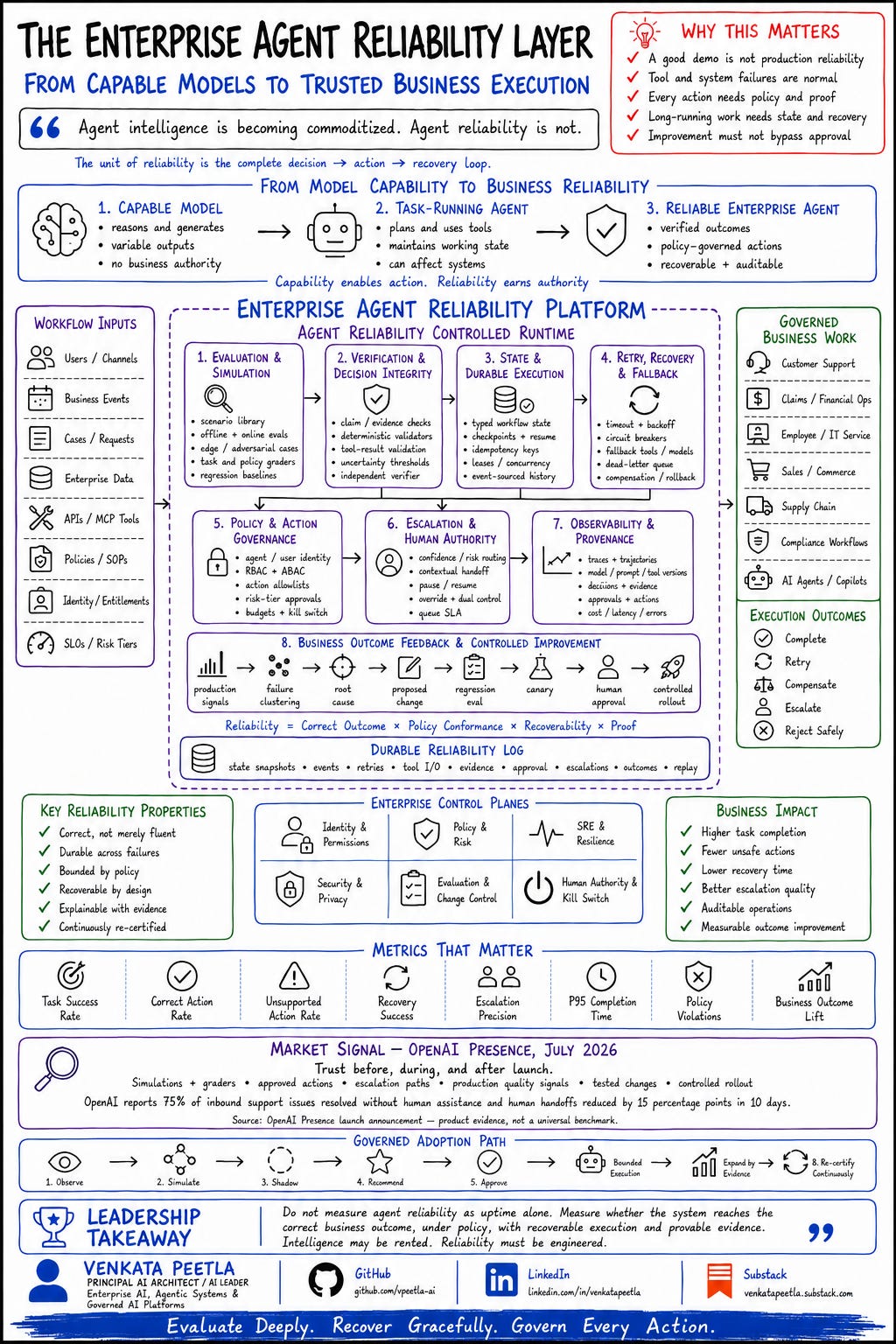
Eight capabilities of the reliability layer
1. Evaluation and simulation
Reliability begins before production.
The platform should maintain a scenario library representing:
common requests
boundary conditions
known failure cases
adversarial inputs
high-risk actions
policy conflicts
dependency outages
changing business state
Evaluation should measure more than response quality.
Useful graders include task outcome, policy conformance, tool selection, tool-argument correctness, evidence support, state-transition correctness, escalation quality, recovery behavior, and business outcome.
Simulation should inject failure deliberately:
return a timeout after an action commits
revoke permission during a task
deliver an event twice
change a policy version
make the primary tool unavailable
introduce conflicting source data
Success on the happy path is not production readiness.
2. Verification and decision integrity
The component producing a decision should not always be the only component validating it.
Verification can include:
claim-to-evidence checking
deterministic business-rule validation
schema validation
tool-result validation
independent model verification
cross-source agreement
uncertainty thresholds
action-precondition checks
Verification should happen before material claims, before irreversible actions, after tool results, and before marking a workflow complete.
High-risk workflows may need a separate verifier or policy decision point that the planning agent cannot override.
3. State and durable execution
Long-running workflows cannot depend only on an in-memory conversation.
The platform needs typed, externalized workflow state:
current and completed steps
pending actions
evidence collected
approvals received
idempotency keys
tool results
retry counters
deadlines
escalation state
Checkpoints allow execution to resume after a worker, model call, sandbox, or downstream service fails.
The architecture should distinguish:
conversation memory
workflow state
business-system state
audit history
Combining these into one opaque memory object makes recovery and verification difficult.
4. Retry, recovery, and fallback
Retries are necessary, but unsafe retries can be worse than failure.
The platform should support:
bounded retry policies
exponential backoff and jitter
timeout budgets
circuit breakers
bulkheads
certified fallback tools or models
dead-letter queues
replay
compensation and rollback
Every side-effecting action needs an idempotency strategy.
When an API times out, the system must determine whether:
the operation did not execute and can be retried
the operation executed but the response was lost
the outcome is unknown and requires reconciliation
a compensating action is available
a human must resolve the ambiguity
“Retry three times” is not a production recovery design.
5. Policy and action governance
Agents should not receive broad business authority merely because they can call a tool.
Action governance should evaluate:
user, agent, tenant, and workload identity
delegated authority
RBAC and ABAC policies
action allowlists
transaction limits
risk tier
separation of duties
required approvals
cost and action budgets
kill-switch status
Permissions should be scoped to the job.
An agent allowed to read account information does not automatically need permission to issue a credit. An agent authorized to issue a small reversible credit may not be authorized to close an account or alter identity data.
Authority should be earned incrementally through evidence.
6. Escalation and human authority
Escalation is not an admission that the agent failed.
It is a designed reliability outcome.
The platform should define:
risk- and uncertainty-based escalation
policy-mandated escalation
queue ownership
response-time SLAs
pause and resume behavior
contextual handoff
human override
dual control for sensitive actions
A good escalation package should include the original intent, resolved identity, current state, collected evidence, policies evaluated, actions attempted, reason for escalation, and recommended next step.
The human should continue the workflow—not reconstruct it from scratch.
7. Observability and provenance
Traditional application logs are insufficient for agent operations.
Agent observability should capture:
traces and trajectories
model and prompt versions
tool versions and arguments
retrieved evidence
state transitions
verification results
policy decisions
approvals
retries and fallbacks
cost and latency
business outcomes
Provenance should answer:
What did the agent know?
Which evidence supported its decision?
Which policies applied?
What action was proposed?
Who or what approved it?
What executed?
What changed in the business system?
What happened afterward?
OpenAI’s Agents platform similarly emphasizes guardrails, tracing, and evaluations as production-building blocks. OpenAI’s agent-building tools.
8. Business-outcome feedback and controlled improvement
Production feedback is valuable, but it must not become uncontrolled self-modification.
A governed improvement loop should:
Capture production sessions, escalations, failures, and outcomes.
Cluster recurring failure patterns.
Identify the likely root cause.
Propose a prompt, policy, tool, workflow, or model change.
Test the change against regression and risk evaluations.
Compare it with the current production version.
Run a canary or shadow deployment.
Require approval based on change risk.
Roll out gradually.
Monitor for regression and preserve rollback capability.
The agent may learn from production.
The production agent should not change itself without governance.
Five valid execution outcomes
An enterprise workflow should not have only “success” and “failure.”
It should deliberately support:
Complete: The correct business outcome was reached and verified.
Retry: A transient, safely repeatable failure occurred.
Compensate: A partial side effect must be reversed or offset.
Escalate: Human judgment or additional authority is required.
Reject safely: The request violates policy, lacks sufficient evidence, or cannot be completed safely.
Reliability means selecting the correct outcome—not maximizing autonomous completion at any cost.
Metrics that matter
Infrastructure metrics remain necessary:
availability
latency
saturation
tool error rate
recovery time
The business and architecture scorecard should also include:
task-success rate
correct-action rate
unsupported-action rate
policy-violation rate
verification-failure rate
retry-success rate
duplicate-action rate
compensation success
escalation precision
unnecessary-escalation rate
evidence coverage
incident-reconstruction completeness
p95 end-to-end completion time
cost per completed outcome
business-outcome lift
Metrics should be segmented by workflow, risk tier, channel, agent version, model version, tool version, and autonomy level.
A single global “agent accuracy” number hides the operational truth.
Governed adoption path
Organizations should expand agent authority through evidence.
Observe: Map the workflow, systems, policies, decisions, failures, and human interventions.
Simulate: Test common, edge, adversarial, and failure-injection scenarios.
Shadow: Compare agent decisions with real outcomes without affecting production.
Recommend: Let the agent propose actions while humans execute.
Approve: Permit actions only after explicit human review.
Bounded execution: Grant authority for low-risk, reversible, well-evaluated actions.
Expand by evidence: Increase autonomy only when outcome, policy, recovery, and provenance thresholds are satisfied.
Re-certify continuously: Re-evaluate whenever models, prompts, tools, policies, data, or business conditions change.
Autonomy should be treated as a dynamic permission—not a permanent deployment state.
Leadership takeaway
The model is not the reliability layer.
The orchestration framework is not the reliability layer.
The evaluation dashboard is not the reliability layer.
Reliability emerges from the complete architecture:
Evaluate → Verify → Persist → Recover → Govern → Escalate → Observe → Improve
Do not measure agent reliability as uptime alone.
Measure whether the system reaches the correct business outcome, under policy, through recoverable execution, with evidence that can be verified and replayed.
Intelligence may increasingly be rented.
Reliability must be engineered.
Which capability is the largest gap in enterprise-agent programs today: evaluation, recovery, action governance, escalation, provenance, or business-outcome feedback?