

Imagine a supply-chain agent is asked:
Can we reroute this delayed shipment, reserve replacement inventory, notify the customer, and protect the committed delivery date?
This sounds like a single request.
Architecturally, it is not.
The agent may need to correlate:
the customer order and delivery commitment
current inventory across warehouses
carrier events and route conditions
supplier and logistics contracts
product-substitution rules
customer communication preferences
regional compliance requirements
approval thresholds
the identity and authority of the requesting user
It must determine which sources are authoritative, which events are current, which policies apply, which actions are permitted, and which evidence must be retained.
A model can reason over the information it receives.
But the model should not be expected to invent the enterprise meaning, access policy, temporal truth, or evidence chain that makes the information usable.
That is the responsibility of an Enterprise Context Layer.
The missing layer in agent architecture
Most agentic AI architecture diagrams emphasize three visible elements:
Models → Agents → Tools
This helps explain orchestration, but it is incomplete for production enterprise architecture.
Agents rarely operate against one clean and authoritative data source. They work across operational databases, SaaS platforms, APIs, event streams, documents, analytical systems, identity services, policies, and workflow state.
The same business entity may have different identifiers across systems.
The same metric may have multiple definitions.
A document may be relevant but no longer effective.
An event may be recent but arrive out of order.
A user may be permitted to see a customer record but not a restricted field within it.
When every agent team solves these problems independently, the organization creates:
duplicated integrations
inconsistent semantics
fragmented security controls
stale context
conflicting answers
weak provenance
high incident-reconstruction costs
The architecture must therefore evolve from:
Applications → APIs → Data
to:
Enterprise Data Estate → Governed Context Layer → Agent Runtime → Governed Action
The Enterprise Context Layer becomes the governed abstraction that transforms distributed data into context that is relevant, authoritative, current, permitted, and evidence-bearing.
Data is not context
Data is an observation, record, document, event, or value.
Information is data that has been retrieved, organized, ranked, or summarized.
Context adds the meaning required to interpret and use that information.
For an enterprise agent, context may include:
the business definition of an entity or metric
the relationship between customer, contract, product, shipment, and policy
current and previous operational state
the effective time of a rule
the requesting user and agent identity
access and purpose limitations
source authority and freshness
supporting evidence and provenance
the actions permitted under the current conditions
RAG can retrieve evidence.
A knowledge graph can expose relationships.
A semantic layer can define business meaning.
Event streams can provide operational change.
Identity and policy systems can determine access.
The Enterprise Context Layer composes these capabilities into one governed runtime contract.
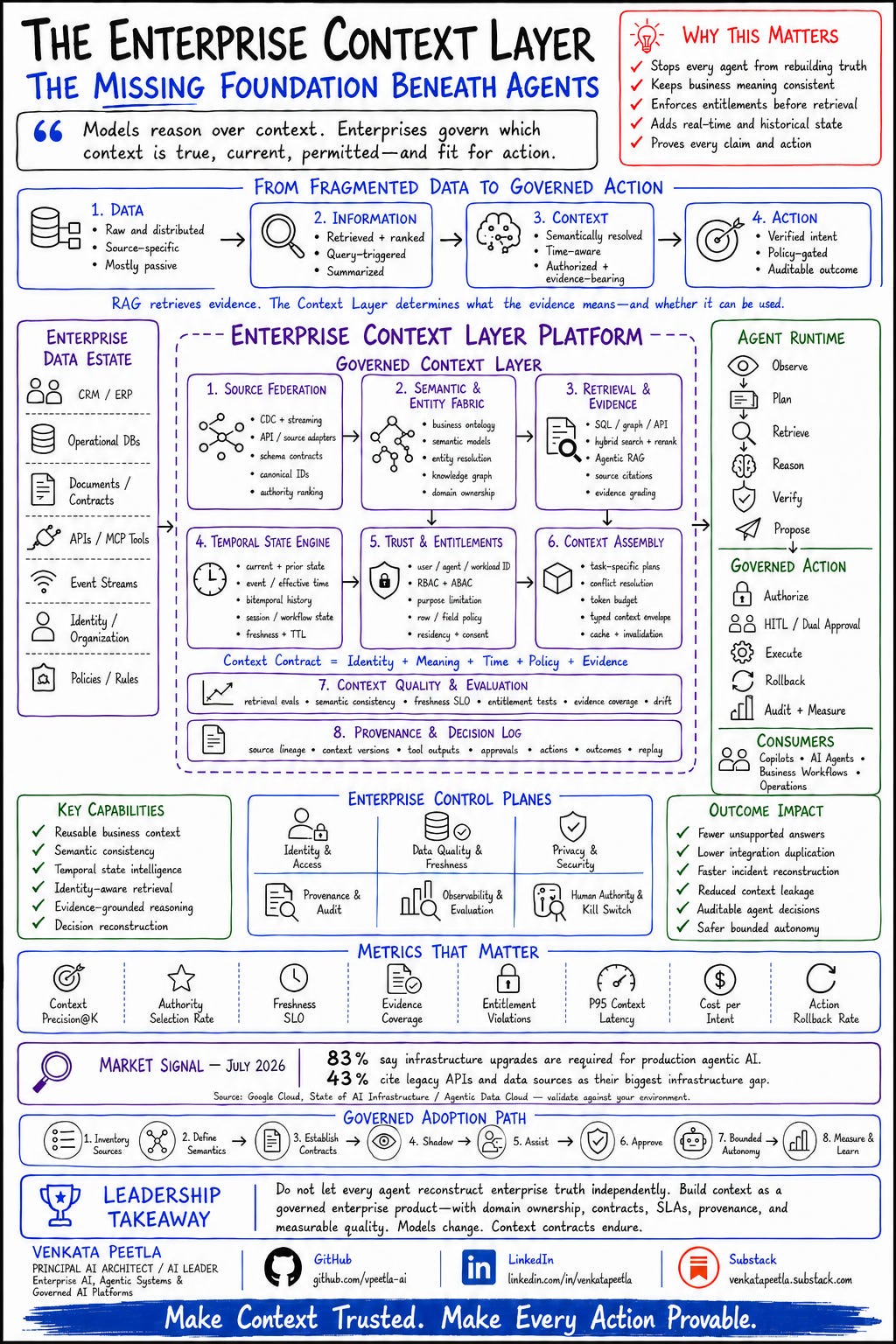
Eight capabilities of the Enterprise Context Layer
1. Source federation
Enterprise context begins with governed access to distributed systems.
The layer should support structured databases, analytical platforms, documents, APIs, event streams, knowledge stores, and operational SaaS applications.
Common capabilities include:
change-data capture and streaming ingestion
source and API adapters
schema contracts
metadata discovery
canonical identifiers
source-authority ranking
The goal is not necessarily to centralize every byte of enterprise data.
A federated architecture may retrieve information close to its source while centralizing governance, semantic contracts, evaluation, and observability.
2. Semantic and entity fabric
An agent must understand enterprise meaning—not merely field names.
This capability can combine:
business glossaries
semantic models
domain ontologies
entity resolution
knowledge graphs
relationship models
domain ownership metadata
The semantic fabric should answer questions such as:
What is the authoritative definition of “available inventory”?
Which customer, account, contract, and order records refer to the same entity?
Which policy governs this product in this geography?
What relationship makes this recommendation relevant?
Semantics should be versioned and governed as domain contracts.
They should not be silently invented by the model at runtime.
3. Retrieval and evidence
The context layer needs multiple retrieval strategies:
SQL and analytical queries
graph traversal
API composition
lexical, semantic, and hybrid search
metadata filtering
reranking
Agentic RAG
Retrieval must consider more than similarity.
Relevant evidence may still be stale, unauthorized, superseded, low quality, or inconsistent with an authoritative source.
The retrieval layer should therefore return source citations, authority signals, freshness, confidence, and evidence-quality indicators.
4. Temporal state engine
Enterprise agents operate in time.
Inventory, pricing, consent, risk, shipment status, account state, and approval authority can change during a workflow.
The context layer should distinguish:
event time from processing time
current state from historical state
valid time from recorded time
active policy from superseded policy
durable memory from session state
fresh context from expired context
Bitemporal history, freshness rules, context expiration, late-event handling, and cache invalidation become essential production capabilities.
An answer can be semantically correct and still operationally unsafe if it was correct five minutes ago but is no longer true.
5. Trust and entitlements
Authorization should occur before sensitive context reaches the model.
The context layer should evaluate:
user identity
agent identity
tenant identity
workload and service identity
role- and attribute-based access
purpose limitation
row-, field-, document-, and relationship-level policy
residency and consent requirements
This prevents a common anti-pattern: allowing the model to retrieve broad context and attempting to control only the final action.
Blocking execution does not reverse unauthorized context exposure.
6. Context assembly
The agent should receive a structured context package—not an arbitrary collection of text chunks.
The assembly service can:
create a task-specific context plan
resolve conflicts between sources
prioritize authoritative evidence
apply token and latency budgets
summarize while preserving citations
attach policy obligations
manage context caching and invalidation
The result is a typed Context Contract.
A useful conceptual formula is:
Context Contract = Identity + Meaning + Time + Policy + Evidence
Depending on the workflow, that contract can include:
user, agent, tenant, request, and session identities
resolved business entities and relationships
task and permitted purpose
relevant facts, documents, events, and summaries
authoritative-source ranking
“as of” time, freshness, and expiration
semantic-model and policy versions
access decisions and obligations
confidence and quality indicators
evidence and provenance references
allowed actions and escalation requirements
7. Context quality and evaluation
Context quality must be evaluated independently from model quality.
Evaluation should measure:
retrieval precision and recall
authoritative-source selection
semantic consistency
freshness-SLO compliance
entitlement enforcement
evidence coverage
conflict-resolution accuracy
drift across sources and semantic models
The deployed AI system should also be tested using realistic context failures:
stale events
conflicting records
revoked permissions
missing evidence
schema changes
ambiguous entities
superseded policies
8. Provenance and decision logging
Traditional logs may show that an agent invoked a tool.
They often do not show:
which context version was used
which sources influenced the decision
which semantic definition applied
which policies were evaluated
what evidence supported each claim
who approved the action
what outcome followed
A context platform should preserve source lineage, context versions, tool outputs, approvals, actions, outcomes, and replayable decision traces.
This supports auditability, incident reconstruction, evaluation, and continuous improvement.
Separate reasoning from authorization
The Enterprise Context Layer does not eliminate the need for an agent runtime or action-governance layer.
These layers have different responsibilities.
The context layer determines:
what information is relevant
what it means
whether it is current
whether it can be disclosed
what evidence supports it
The agent runtime determines:
how to plan the task
what additional context is needed
which tools to propose
how to reason over the assembled context
what action should be recommended
The governed-action layer determines:
whether the intent is authorized
whether human or dual approval is required
whether the connector can execute it
whether the action should be rate-limited or blocked
how to roll back or compensate
what outcome must be recorded
This separation creates stronger control boundaries.
The agent can propose an action without automatically receiving the authority to execute it.
Enterprise control planes
The Enterprise Context Layer should integrate with enterprise-wide control planes:
Identity and access: User, agent, workload, tenant, and delegated authority.
Data quality and freshness: Schema contracts, source reliability, freshness SLAs, and quality incidents.
Privacy and security: Classification, residency, consent, encryption, and purpose restrictions.
Provenance and audit: Source lineage, context versions, policy decisions, and evidence chains.
Observability and evaluation: Context latency, retrieval behavior, cost, failures, drift, and task outcomes.
Human authority: Approval thresholds, separation of duties, escalation, overrides, and kill-switch capabilities.
These controls should be platform capabilities—not repeatedly reimplemented by individual agent teams.
Production failure modes
Every agent connects directly to every source
Each team creates separate credentials, connectors, caching, retrieval logic, and semantic assumptions.
Security and behavior drift rapidly.
RAG is treated as the entire context architecture
The agent retrieves similar text but cannot determine authority, effective time, entitlement, or action fitness.
Context-window stuffing
More tokens are assumed to mean better context.
Cost and noise increase while conflicting facts become harder to resolve.
Business meaning is generated by the model
The model infers definitions that should come from governed domain semantics.
Authorization happens only before execution
Sensitive information reaches the model before policy evaluation.
Blocking the final action does not correct the exposure.
Stale context has no expiration
The system lacks an “as of” time, freshness SLA, TTL, or invalidation mechanism.
Audit logs omit decision provenance
The system records tool calls but cannot reconstruct the evidence, semantics, policies, and approvals behind a decision.
Metrics that matter
The Enterprise Context Layer should be managed as a measurable enterprise product.
Useful metrics include:
Context Precision@K
authoritative-source selection rate
freshness-SLO compliance
evidence coverage
entitlement-violation rate
p95 context-assembly latency
context cost per resolved intent
stale-context incident rate
semantic-conflict rate
decision-reconstruction completeness
action rollback or compensation rate
context reuse across agents and workflows
The critical evaluation question is not merely:
Did the system retrieve something relevant?
It is:
Was the context sufficiently authoritative, current, permitted, and evidence-backed for this decision and action?
Centralized or federated?
A centralized context platform can improve consistency, reuse, policy enforcement, and observability.
But it can also become a latency bottleneck, a data-movement problem, or another monolithic enterprise platform.
A fully decentralized model preserves domain autonomy but risks inconsistent contracts, duplicated controls, and fragmented evidence.
For large enterprises, a federated model is often more defensible:
centralized context contracts and platform standards
centralized identity, policy, catalog, evaluation, and observability
domain-owned semantics and authoritative data products
distributed retrieval and execution near the source
shared evidence and provenance requirements
The platform team owns the paved road.
Domain teams own business meaning and source authority.
Security and risk teams own policy requirements.
Business owners define acceptable autonomy and measurable outcomes.
Governed adoption path
The Enterprise Context Layer does not need to begin as one large transformation program.
A safer adoption path is:
Inventory the systems, entities, policies, and evidence required for one high-value workflow.
Define authoritative sources and domain semantics.
Establish context contracts and freshness expectations.
Run in shadow mode and compare assembled context with human decisions.
Introduce assistive recommendations.
Add policy-gated approval workflows.
Permit bounded automation only for low-risk, reversible actions.
Measure outcomes, failures, overrides, and context quality.
This creates operational proof before autonomy expands.
Leadership takeaway
The model is not the enterprise memory.
The vector database is not the enterprise truth.
The agent framework is not the enterprise policy engine.
Production agents need a durable foundation connecting:
Identity + Meaning + Time + Policy + Evidence
That foundation is the Enterprise Context Layer.
The leadership decision is not simply which technology to buy.
It is whether the organization will continue allowing every agent team to reconstruct enterprise truth independently—or establish context as a governed, reusable, measurable enterprise product.
Models will change.
Agent runtimes will change.
Retrieval technologies will change.
Context contracts should endure.
Where should the Enterprise Context Layer live in your organization: the data platform, the AI platform, or a shared enterprise architecture capability?
Sources
The market evidence and architecture signal draw on Google Cloud’s July 2026 discussion of business context, semantic meaning, and nonlinear agent infrastructure demand, its universal context engine architecture, and its guidance on real-time context and avoiding context lag.